From Space to the Healthy Aging in Living Room: The Real Story Behind Vibration Plates
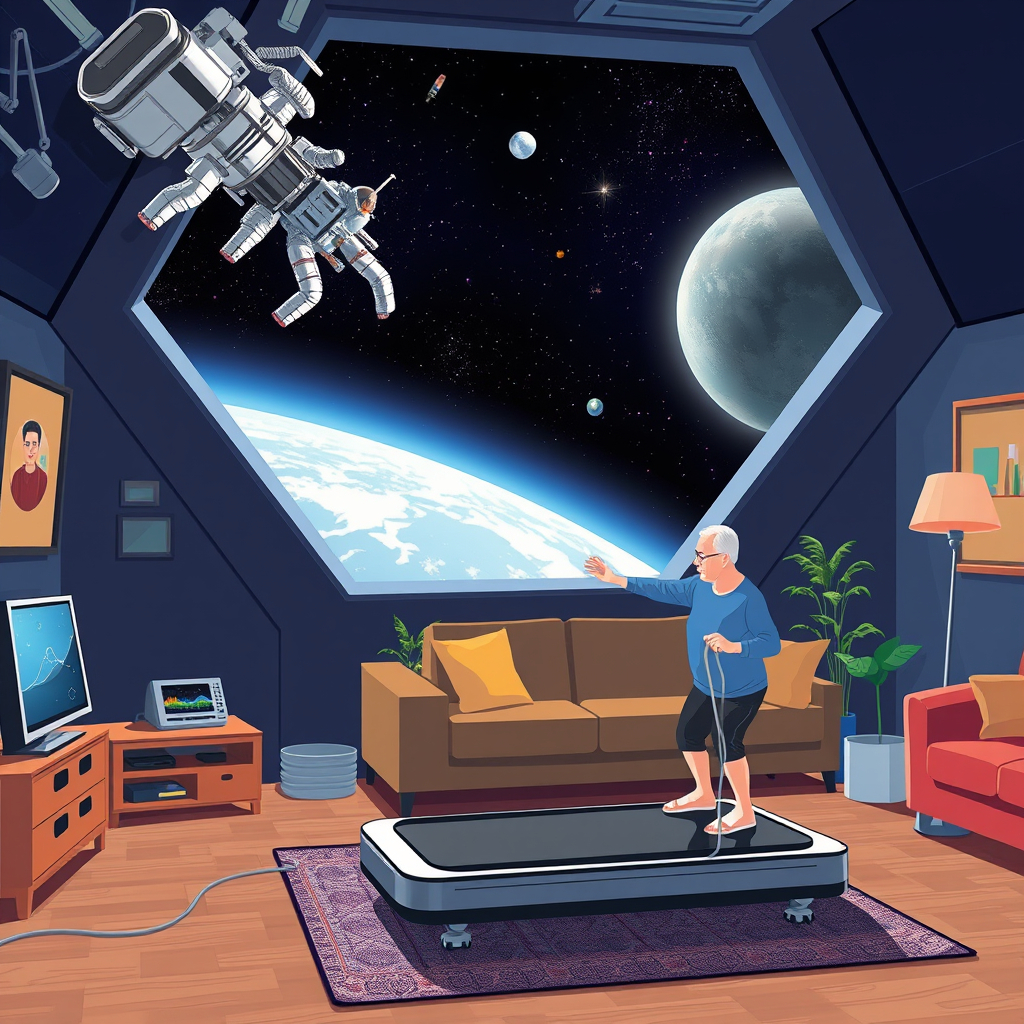
If you’ve ever stepped onto a vibrating plate and thought, “This feels like standing on a tiny helicopter,” you’re not alone.
But here’s the surprising part: the idea of using mechanical signals to protect bone and muscle didn’t just come from gyms. It’s closely linked to a problem that space agencies have been trying to solve for decades:
How do you stop the human body from losing bone and muscle when gravity disappears?
NASA explains that in microgravity, weight-bearing bones can become roughly ~1% less dense per month without countermeasures, and muscles weaken because they don’t have to fight gravity the way they do on Earth.
That’s where the “space origin” story comes from. The more accurate version is:
So—let’s unpack what vibration plates (often called Whole-Body Vibration, or WBV) actually do, what the evidence says for older adults, and how to use them safely.
What “Whole-Body Vibration” Actually Is
A vibration plate is a platform that generates controlled oscillations. When you stand (or sometimes sit or perform simple movements) on it, your body automatically does a lot of tiny stabilizing contractions.
Think of WBV as a signal amplifier:

Why Space Research Matters (and why it’s relevant to your grandparents)
The “space problem”
In microgravity, the body gets fewer of the normal mechanical signals it relies on to maintain bone and muscle. NASA has long studied different countermeasures, including exercise systems and approaches involving mechanical loading signals.

The “Earth version” of the same problem
Many older adults experience a slow-motion version of that “unloading”:
WBV is interesting because it tries to reintroduce mechanical stimulation without requiring high impact.
How WBV May Help: The Big 5 Areas People Ask About
1) Osteoporosis: “Can it improve bone density?”
Possibly, but expect modest effects—and not at every skeletal site.
A 2025 systematic review/meta-analysis found low-certainty evidence of improvements at some regions (e.g., total femur) over ~18–32 weeks, but not consistently at femoral neck or lumbar spine. An updated meta-analysis (2026) also evaluates bone mineral density effects in older adults, reflecting continued interest and ongoing refinement of the evidence base.
What this means for the public: WBV may be a helpful support tool, especially for people who can’t yet tolerate higher-impact or heavier resistance work. But if your goal is bone protection, the strongest foundations still include weight-bearing activity, resistance exercise, balance work, and medical management when needed.
2) Sarcopenia (muscle loss): “Can it build muscle?”
WBV is more consistently linked to improvements in strength and physical function than to large increases in muscle size—especially in older adults already diagnosed with sarcopenia.
A 2025 systematic review suggests WBV can improve muscle strength in older adults (with or without sarcopenia), with outcomes influenced by how it’s delivered (frequency/amplitude, position, program design). A 2025 randomized study comparing WBV with resistance training found both helped, with resistance training often winning on strength, while WBV served as a lower-barrier alternative for those with restrictions.
Takeaway: WBV can be a “starter engine” or a complement — especially for people who:
3) Balance disorders: “Can it reduce falls?”
Balance is not just leg strength — it’s sensory input + reflexes + coordination + confidence.
A network meta-analysis comparing different WBV frequencies suggests WBV can improve balance in older adults, and that protocol differences matter. Older foundational reviews also support positive effects on balance/mobility outcomes, though the quality and consistency of trials vary.
Takeaway: WBV may help balance, but it works best as part of a broader plan:
4) “Vascular degeneration” / circulation: “Does it help blood flow?”
Evidence suggests WBV can increase muscle contractions and may influence microvascular blood flow — one reason researchers are exploring it for populations who struggle with walking-based exercise (e.g., pain or limited mobility). There is also clinical research examining WBV and endothelial function (a marker related to vascular health) in older adults with stable cardiovascular disease.
A 2025 review discusses WBV’s potential benefits across neuromuscular stability, balance, and cardiovascular-related outcomes in elderly populations, while emphasizing variability in evidence quality.
Takeaway: WBV may support functional circulation markers for some people, but it is not a replacement for cardiovascular care, walking training when possible, or medical treatment for vascular disease.
5) General muscle conditioning: “Is it good for people who are ‘not athletic’?”
This is where WBV can shine.
For many older adults, the hardest part is not knowing what to do—it’s starting. WBV can offer:
In other words: it can help you get from zero to something—and that alone is often a major health win.
Safety First: A “Pre-Flight Check” Before You Step On
WBV is generally considered feasible and has been studied even in medically complex settings when contraindications are respected—but screening matters.
Common situations requiring medical clearance or professional supervision may include:
Contraindication lists differ across settings, and not all are equally evidence-based—so the safest move is: if you’re unsure, ask a healthcare professional who can review your medical history and goals.
How to Use a Vibration Plate (a beginner-friendly approach)
This is general education — not a prescription — but here’s a sensible progression many supervised programs resemble.
Step 1: Start “boringly easy” (Week 1–2)
Step 2: Add gentle functional moves (Week 3–6)
Step 3: Combine with “real builders” (ongoing)
For osteoporosis and sarcopenia prevention, organizations emphasize:
WBV can be the warm-up, the bridge, or the add-on—but long-term bone and muscle resilience usually comes from progressive strength and functional training.
Myth-Busting
Myth 1: “It was invented for astronauts, so it must be super powerful.”
Space research does inspire the science, but that doesn’t mean every consumer plate is equivalent—or that stronger vibration is always better. NASA’s discussion emphasizes the seriousness of bone/muscle loss and the need for carefully designed countermeasures.
Myth 2: “I can replace strength training with vibration.”
WBV can improve function and strength for some people, but research comparing WBV with resistance training often shows resistance training remains the stronger “builder,” while WBV offers a lower-barrier alternative or complement.
Myth 3: “More vibration = faster results.”
Not necessarily. Safety, tolerance, posture, and program design matter. Excessive exposures can be problematic—vibration is also studied as an occupational hazard in other contexts, which is why exposure guidance exists.
The Bottom Line: Where WBV Fits Best
Vibration plates are best thought of as a tool, not a cure:
If you’re caring for an older parent (or planning your own “future-proof body”), the most powerful strategy is still a system:
WBV can be one runway in that flight plan—especially for people who need a gentler takeoff.
Want a practical next step?
If you have osteoporosis, sarcopenia risk, balance concerns, or circulation limitations, consider a professional assessment that measures:
Then decide whether WBV belongs in your plan—and how to dose it safely.
(And yes — if it feels like “tiny turbulence,” that’s normal. The goal is controlled turbulence… not a storm.)